Back to product knowledge
Running a calendar season on a wire 3:1 line
Calendar work arrives in a block and leaves in a block: a few thousand units in eight weeks, then nothing until next year. The machine that handles it does one thing the rest of the range does not — it punches the hanger slot in the same stroke as the binding holes.
Why the slot needs its own punch
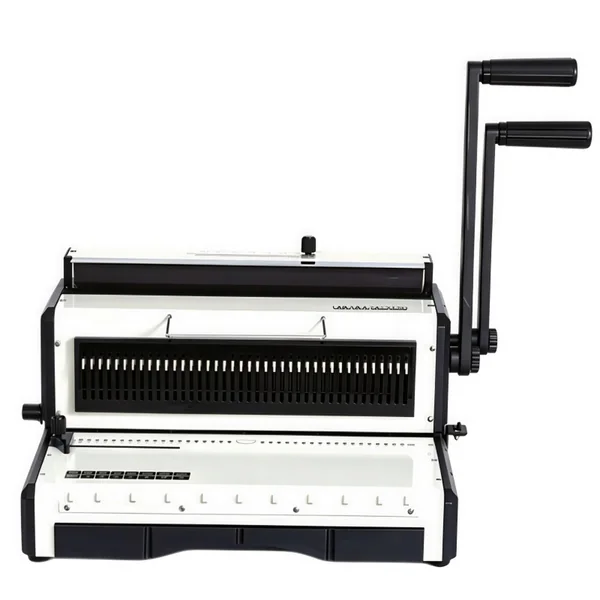
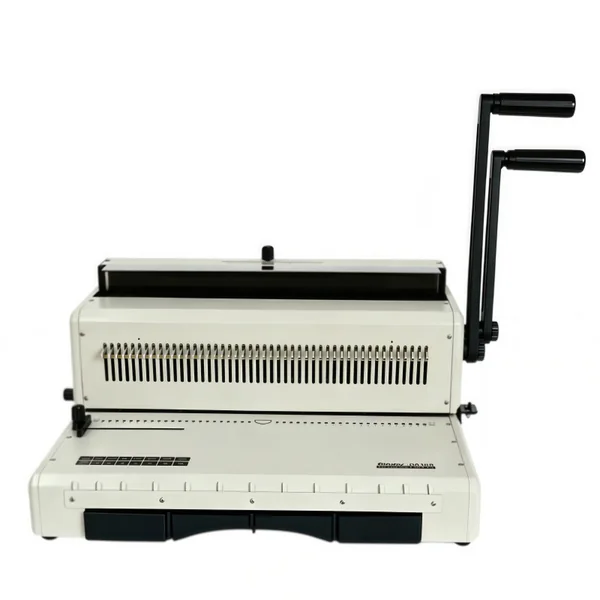
A wall calendar hangs from a slot punched in the head. On a standard 3:1 die that slot is a second pass: realign the stack, punch again, and accept the sheets that shift. Calendar models such as the G930 series carry the slot punch on the same die, so one stroke produces the binding holes and the hanger slot together.
Match the loop to the calendar block
3:1 wire covers 6.4 mm to 15.9 mm loops, which is the whole range a desk or wall calendar needs. Larger loops hold a heavier block but need a 2:1 die, and a 2:1 calendar is unusual because the hanger slot is a 3:1 feature. Check the loop diameter against the sheet count before quoting a thick calendar.
Plan the run around the punch, not the binder
Closing wire takes seconds; punching sets the pace. On a manual handle a long calendar run is limited by the operator, not by the machine. Electric punch models hold the same hole quality at the end of a shift, which is usually where rejects appear.
Keep one die spare
Calendar dies take the hardest work of the year in the shortest window. A spare die and a set of punch pins on the shelf turn a stopped line into a two-hour change; without them, one damaged pin can end the season early.
Models mentioned in this note
G930A
Wire 3:1 Binding MachinesF4 Wire 3:1 binding machine- Max punch
- 20
- Max bind
- 120 (6.4 – 14.3 mm wire)
- Width
- 340 + paper extension
G930B
Wire 3:1 Binding MachinesA3 Wire 3:1 binding machine- Max punch
- 20
- Max bind
- 120 (6.4 – 14.3 mm wire)
- Width
- 420 + paper extension
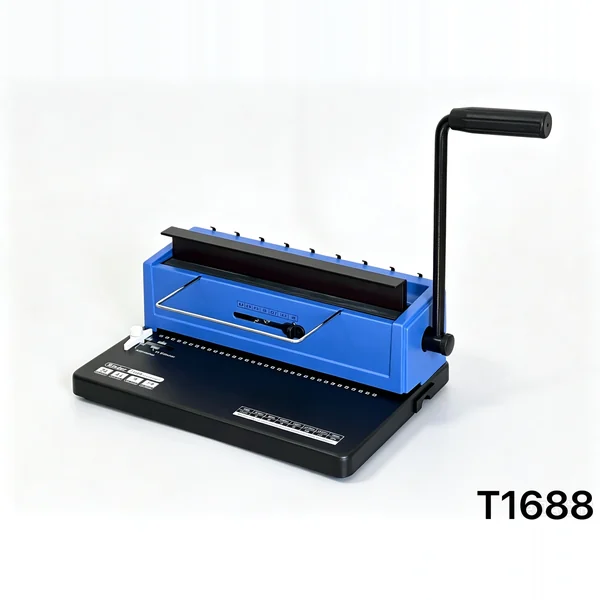
T1688
Wire 3:1 Binding MachinesA4 Wire 3:1 binding machine- Max punch
- 18
- Max bind
- 140 (6.4 – 15.9 mm wire)
- Width
- 297
Knowledge