Binding systems
One machine, ten die sets: interchangeable die binding systems
Comb, 3:1 and 2:1 twin wire, 4:1 and 5:1 spiral coil and calendar binding all start from the same holes. Swap the die cassette instead of buying a second machine — electric D600 or manual M600.
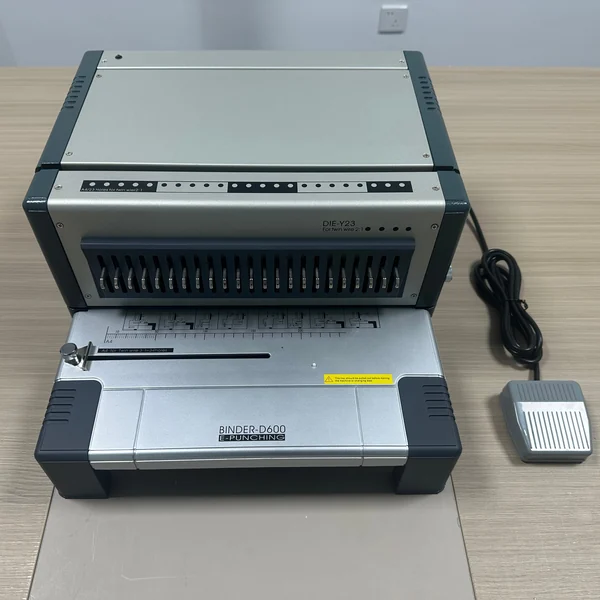
Ten die sets
Drop-in cassettes shared by the D600 and the M600. Hole count, pitch and hole size as published for the ten sets.
| Die | Holes | Pitch | Hole size |
|---|---|---|---|
| DIE-F21 | 21 rectangular | 14.25 mm | 3 × 8 mm |
| DIE-F35 | 35 square | 3:1 (8.47 mm) | 4 × 4 mm |
| DIE-Y35 | 35 round | 3:1 (8.47 mm) | Ø 4 mm |
| DIE-F23 | 23 square | 2:1 (12.7 mm) | 6 × 6 mm |
| DIE-Y23 | 23 round | 2:1 (12.7 mm) | Ø 6 mm |
| DIE-Y59 | 59 round | 5:1 (5 mm) | Ø 3.25 mm |
| DIE-Y49 | 49 round | 4:1 (6 mm) | Ø 4 mm |
| DIE-Y47 | 47 round | 4:1 (6.287 mm) | Ø 4 mm |
| DIE-FHM | 35 square | 8.46 mm | 4 × 4 mm |
| DIE-YHM | 35 round | 8.46 mm | Ø 4 mm |
Punching is not binding
The D600 makes the holes. It does not close a comb, a wire loop or a coil — that is a second machine, and it depends on the system you sell.
- Comb and twin-loop wire: add an S600 binder. It closes 21- and 24-ring combs and 3:1 or 2:1 wire from 3/16" to 1 1/4".
- Spiral coil and channel binding: the D600 still only punches. You need a coil inserter or a channel binding station to finish the book.
- What the die changes is the pitch, not the footprint: one host on the bench covers every system you quote.
Tell us the pitch you sell and we will quote the host plus the dies
Dies are ordered separately, so you only buy the pitches your customers ask for. Your brand on the machine and carton, and mixed containers, can go on the same order.